

Top photo: Marcelo Martins
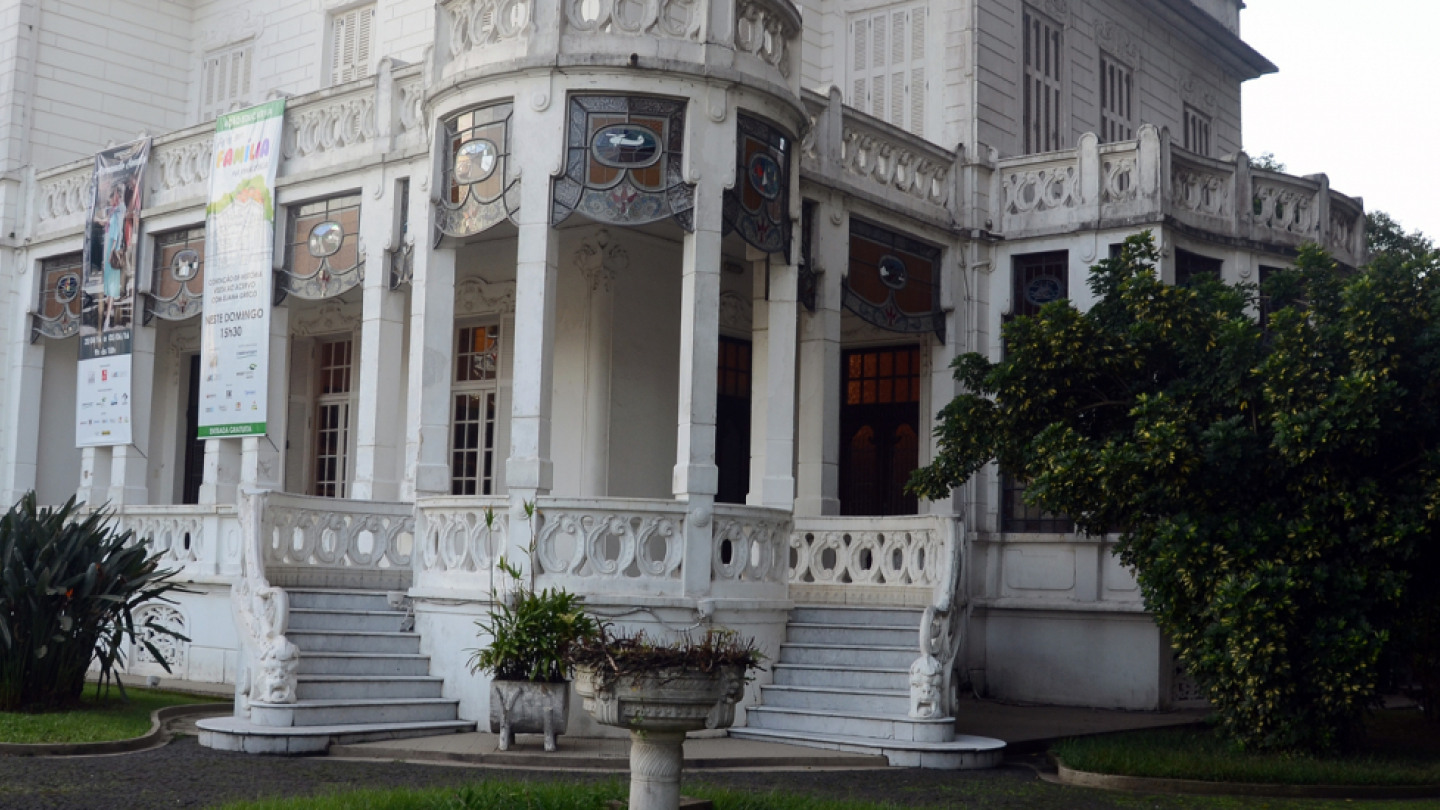
Hosted in a beautiful neoclassical mansion from the early 20th century, the Benedicto Calixto Art Gallery is an important cultural space in the city, offering musical happy hours, courses, and various events for children and adults, especially on weekends.
The house, the last on the Santos coastline that retains the characteristics of the era of the coffee barons, served as a family residence, a retirement home, a boarding house for young women, and even a tenement, before being declared a public utility in 1979 and beginning its restoration seven years later.
On the ground floor are an art library and a permanent exhibition of works by Calixto, considered one of the greatest exponents of Brazilian painting from the early 20th century. The upper floor functions as a gallery for temporary exhibitions.
Gardens
In the gardens, the public can admire sculptures, such as the piece donated by the Santa Catarina-born visual artist Bia Dória, a representative of sustainable contemporary art whose works are made from managed forest waste, sustainable products, and native trees rescued from fires, deforestation, riverbeds, and dams.
Photo: Susan Hortas
Spaces
The interior spaces are decorated in Art Nouveau style, and each room has a specific purpose. The lower floor had a living room, a grand hall, a dining room, an office, a library, and a winter garden. The bedrooms were located on the upper floor.
Photo: Marcelo Martins
Works
The art gallery houses 65 works by Benedicto Calixto, considered one of the four giants of São Paulo's visual arts scene in the 20th century, alongside Almeida Júnior, Pedro Alexandrino, and Oscar Pereira da Silva.
The collection, on permanent display, includes 15 anatomical studies, 14 seascapes, 12 historical paintings, 11 portraits, 10 sacred works, and a nude, as well as brushes, a paint box, and some photographs of Calixto.
Photo: Marcelo Martins
Calixto Café Bistro
Located in the Pinacoteca gardens, Café Bistrô Calixto operates from 12 pm to 10 pm, offering breakfast, lunch, afternoon tea, happy hour, and dinner. Access is also possible via Avenida Epitácio Pessoa, 100, and the telephone number for reservations is (13) 3394-2410.
Photo: Marcelo Martins
A little history
The white mansion was built in 1900 by Carl Anton Dick as a family residence. Ten years later, it was sold to the family of Francisco da Costa Pires, who remained in the house until 1913. In that year, the building housed the Asilo dos Inválidos (today Casa do Sol).
In 1921, the Pires family repurchased the property and renovated it, giving it its current characteristics – Art Nouveau style facade and interior, Carrara marble staircase, solid iron railing, more rooms, frescoes, and a winter garden.
Outside, there is a tennis court, servants' quarters, a classroom, an orchard, a fountain, pergolas, and a large avenue lined with jambolan trees.
The mansion was sold in 1935 and functioned for two years as a boarding school for young women, when the Canero family bought it as their residence. In 1979, the property was declared of public utility, restored, and in 1992, it became the headquarters of the Benedicto Calixto Art Gallery Foundation – Edith Pires Gonçalves Dias, who spent a good part of her life in the white mansion on the beach, was on the board.
Photo: Francisco Arrais