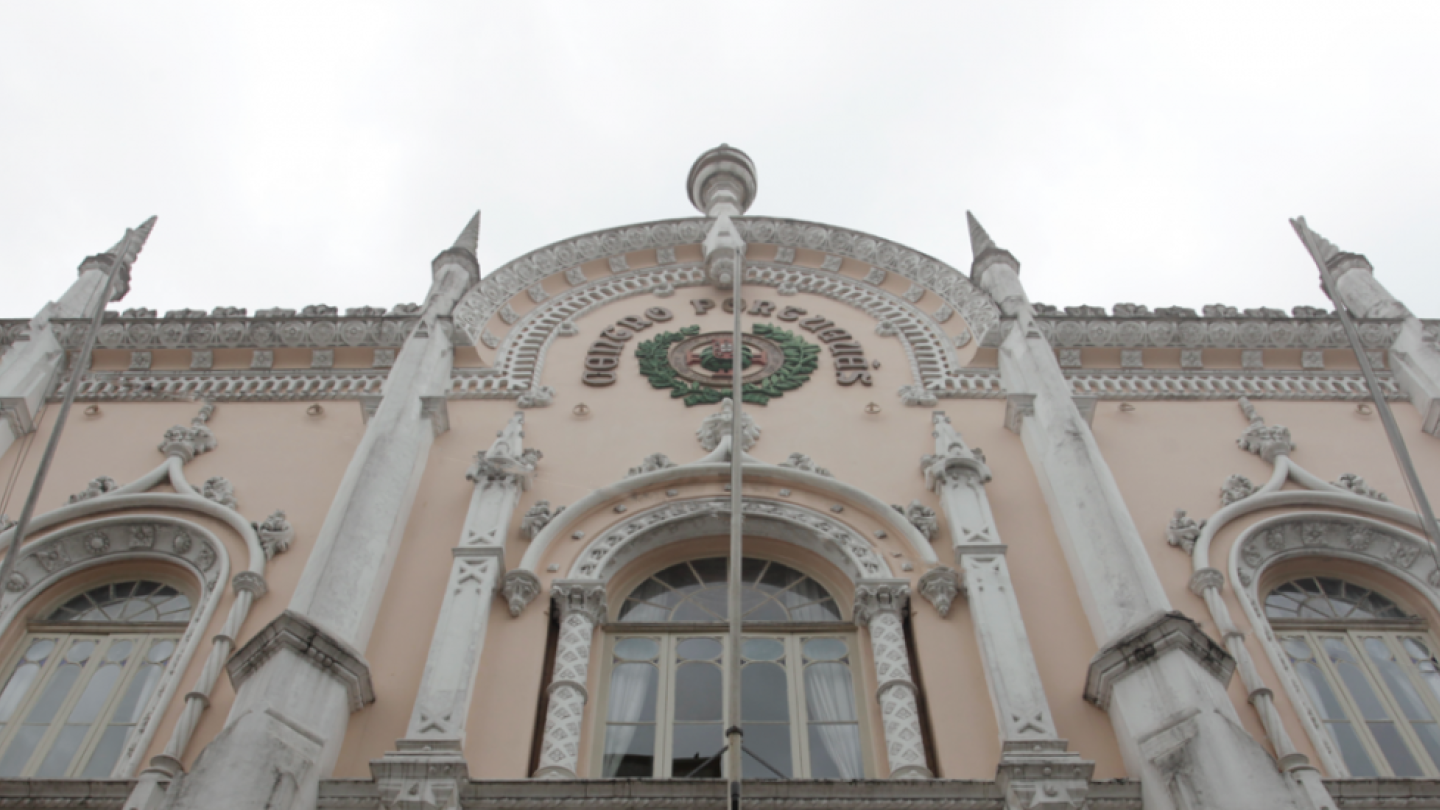


Top photo: Ronaldo Andrade
The only construction in Neo-Manueline style in São Paulo State and one of the few in Brazil, this building was inaugurated in 1900, still unfinished, after two years’ work – the project by two Portuguese engineers was concluded in the following year. In 1945, the Royal Portuguese Center was renamed the Portuguese Center and in 2006, merging with the Portuguese Social Union, was given the name of Portuguese Cultural Center. The older building is the administrative and cultural headquarters, while the other unit holds social activities.

The Construction
Built thanks to donations, auctions, raffles, and festivals, the building features motifs characteristic of the Neo-Manueline style: round arched windows and doors, with ropes, stars, Crosses of Christ, royal shields, and armillary spheres between slender column-shaped trunks with spirals at the ends. Other buildings in the same style include: Real Gabinete Português de Leitura (1880-1887) and the Liceu Literário Português, in Rio de Janeiro; Gabinete Português de Leitura, in Salvador (Bahia, 1915-1918), and the Henry Gibson mansion, in Recife (Pernambuco, 1847).
Photo: Ronaldo Andrade

Cardinal Cerejeira Hall
The former Games Room and Ladies' Room is named after the Cardinal Patriarch of Lisbon, who visited the building in 1946. It houses a Steinway & Sons piano (1876), and a steel safe with a glass top that arrived from Portugal in 1947. This safe contains soil extracted from the Castle of Guimarães (the birthplace of Portuguese nationality) and stones from the Promontory of Sagres, where Prince Henry founded his school of nautical studies and from where the first ships departed toward the Discoveries. Next to it is an 1880 edition of Os Lusíadas, with a dedication to D. Pedro II, an epic poem in which Luiz de Camões describes, in verse, the history of Portugal and extols the deeds of its people.
Photo: Ronaldo Andrade

Camonian Hall
Decorated by the Spanish artists Antonio Fernandez and João Bernils, it is rich in details and curiosities: a chair made of araribá-do-norte wood commissioned for King D. Carlos (he was scheduled to visit Santos in 1911, but was assassinated in Portugal two months before the scheduled date); tables with royal symbol carvings; oil paintings; ceiling panels reproducing verses from Os Lusíadas; paintings by Benedicto Calixto (1905) and Charleaux (1953) on the walls, among works by unknown authors.
Photo: Rosangela Menezes

Camões' Grotto in Macau (Canto I, Stanza X)
You will see the love of the homeland, not moved By vile, but high and almost eternal reward: For it is no vile reward to be known By a proclamation from my paternal nest. Listen: you will see the name magnified Of those of whom you are supreme lord, And you will judge which is more excellent, Whether to be King of the world, or of such people.
Photo: Acervo Centro Cultural Português