

Top photo: Anderson Bianchi
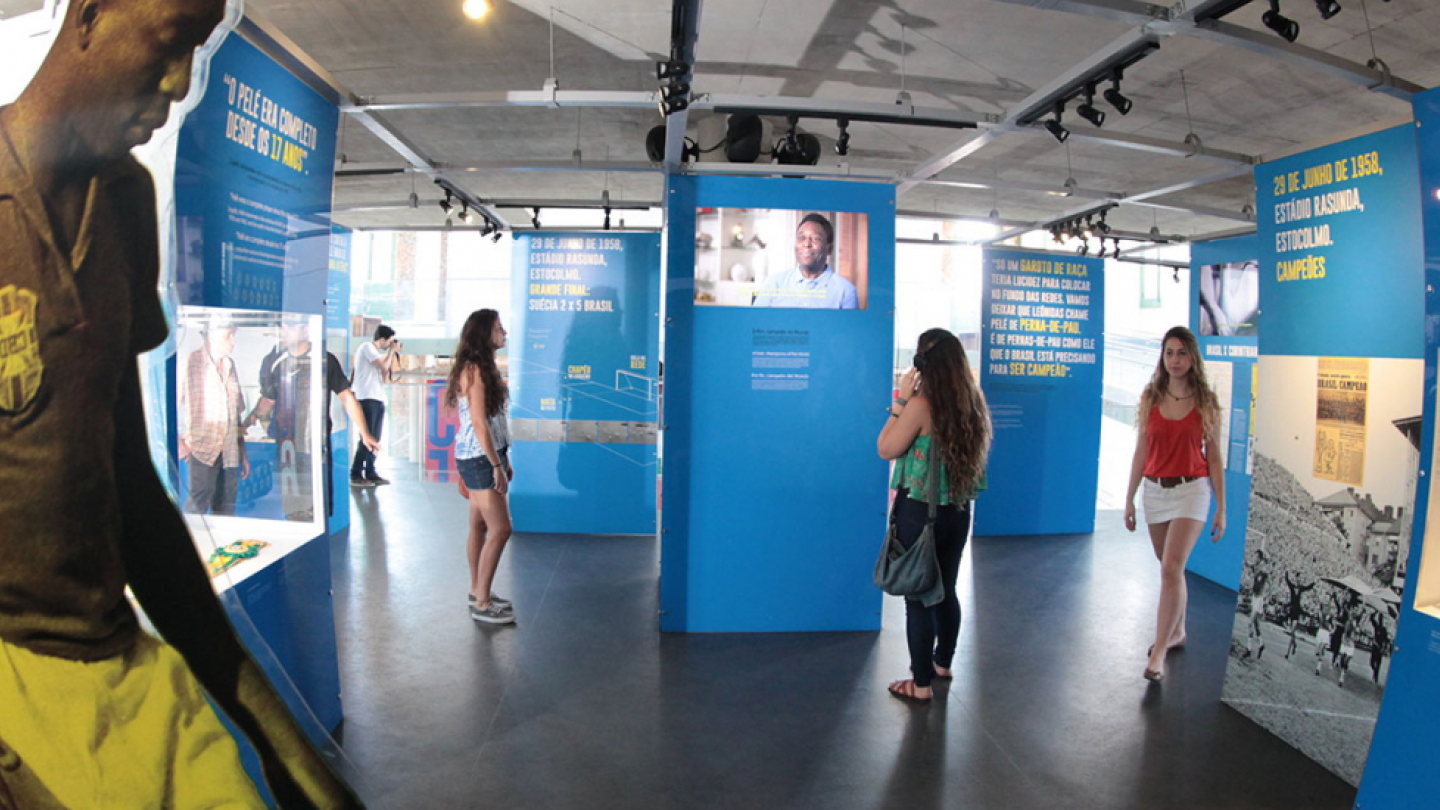
Installed inside the 19th -century Casarões do Valongo, which were damaged by two fires and then completely rebuilt, the Pelé Museum exhibits shirts, football boots, balls, honors and awards, trophies, a football made of socks and a shoeshine box, among other items from the personal collection of "The Athlete of the 20th Century". There are 2,354 items in all, to be displayed in rotation, according to exhibition theme (the first is "4 Cups and 1 King). In the museum's 4,134 square meters the public can also enjoy audio presentations, films, photos and texts about the history of the "King" As well as this, there is an interactive space where visitors can test their ball skills and even compare them to Pelé's performance.
The King
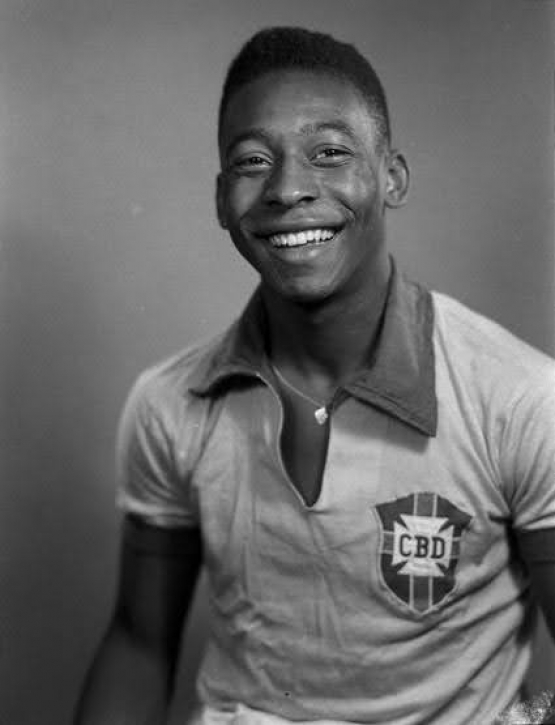
Athlete of the 20th Century, idolized around the world, Edson Arantes do Nascimento began playing for Santos Football Club in 1956. There, the career of the most important figure in sports history began.
With immense talent and surprising genius, Pelé was an unparalleled player, surpassing all records in football and being recognized across all sports as the Athlete of the 20th Century.
It is difficult to find words to define what the star of Santos, the team with which he became world champion in 1962 and 1963, and the Brazilian national team, where he won the World Cups of 1958 in Sweden, 1962 in Chile, and 1970 in Mexico, meant to the sport.
In nearly 21 years of play, Pelé scored 95 goals with the national team and another 1,091 for Santos. These were true masterpieces on the pitches of the country and around the world, leading the entire planet to revere His Majesty.
Magical on the fields and enchanting millions around the globe, Pelé simultaneously served as an ambassador for Santos, establishing an inseparable link between the player and the city.
If Santos was already recognized internationally for its coffee and for having the largest port complex in Latin America, the association with Pelé expanded the city's name to the farthest territories.
For the projection that he brought to the city in nearly 70 years, for the joy and pride he gave to the people of Santos, the city has infinite gratitude for this incomparable figure.
The result of the long effort by the athlete himself, municipal and state authorities, and the support of the population, the city is proud to have delivered one of the King's greatest dreams: the Pelé Museum. On the eve of the 2014 World Cup, its inauguration moved him to tears. "I thank God for giving me the health to receive this honor."
With a wide collection of the Athlete of the Century's career, the museum holds documents, jerseys, shoes, balls, decorations, trophies, personal items, audio recordings, films, photos, and texts from the time he was a boy until he became an idol. Beyond just displaying objects, it is an honor for the city, which he so widely promoted, to be responsible for preserving this material of interest to tourists from Brazil and abroad.
The constellation of figures who have elevated the name of the city, such as José Bonifácio de Andrada e Silva, Father Bartolomeu de Gusmão, Saturnino de Brito, and Quintino de Lacerda, now shines with the addition of another star: Pelé.
The King
Athlete of the 20th Century, idolized around the world, Edson Arantes do Nascimento began playing for Santos Football Club in 1956. There, the career of the most important figure in sports history began.
With immense talent and surprising genius, Pelé was an unparalleled player, surpassing all records in football and being recognized across all sports as the Athlete of the 20th Century.
It is difficult to find words to define what the star of Santos, the team with which he became world champion in 1962 and 1963, and the Brazilian national team, where he won the World Cups of 1958 in Sweden, 1962 in Chile, and 1970 in Mexico, meant to the sport.
In nearly 21 years of play, Pelé scored 95 goals with the national team and another 1,091 for Santos. These were true masterpieces on the pitches of the country and around the world, leading the entire planet to revere His Majesty.
Magical on the fields and enchanting millions around the globe, Pelé simultaneously served as an ambassador for Santos, establishing an inseparable link between the player and the city.
If Santos was already recognized internationally for its coffee and for having the largest port complex in Latin America, the association with Pelé expanded the city's name to the farthest territories.
For the projection that he brought to the city in nearly 70 years, for the joy and pride he gave to the people of Santos, the city has infinite gratitude for this incomparable figure.
The result of the long effort by the athlete himself, municipal and state authorities, and the support of the population, the city is proud to have delivered one of the King's greatest dreams: the Pelé Museum. On the eve of the 2014 World Cup, its inauguration moved him to tears. "I thank God for giving me the health to receive this honor."
With a wide collection of the Athlete of the Century's career, the museum holds documents, jerseys, shoes, balls, decorations, trophies, personal items, audio recordings, films, photos, and texts from the time he was a boy until he became an idol. Beyond just displaying objects, it is an honor for the city, which he so widely promoted, to be responsible for preserving this material of interest to tourists from Brazil and abroad.
The constellation of figures who have elevated the name of the city, such as José Bonifácio de Andrada e Silva, Father Bartolomeu de Gusmão, Saturnino de Brito, and Quintino de Lacerda, now shines with the addition of another star: Pelé.

Timeline
In the timeline, visitors learn about the poor childhood of young Edson in the city of Três Corações, Minas Gerais, as he takes his first steps in football in the city of Bauru, São Paulo, progresses to his arrival at Santos Football Club, and debuts with the Brazilian national team, culminating in his dozens of achievements on pitches around the world.
Photo: Susan Hortas

Childhood
At just seven years old, Pelé gathered pieces of wood and, with the help of his uncle Jorge, made a shoe-shining box and went in search of customers at the Bauru train station (São Paulo). It was with this box that young Edson earned his first money: a 400 réis coin. Pelé would listen to football games on this radio with his father. It was through this radio that his father, Dondinho, heard the commentary about Brazil's defeat in the 1950 World Cup final against Uruguay – it was the first time Pelé saw his father cry. He promised his father that he would win a World Cup, a promise that came true eight years later.
Photo: Susan Hortas

Trophies
By winning the World Cup three times (1958 in Sweden, 1962 in Chile, and 1970 in Mexico), Brazil secured the permanent possession of the Jules Rimet Trophy. The trophy measured 35 cm in height and weighed 3.8 kg – it was stolen in England in 1966 but was found by a dog; it disappeared again in Rio de Janeiro in 1983. An identical replica was donated by the Mexican government after the 1970 World Cup. Since Pelé never played for a European team, he was never eligible for FIFA's Ballon d'Or. This injustice was rectified on January 13, 2014, when the King of Football received the trophy in recognition of his entire career.
Photo: Susan Hortas

Royal Collection
During the 1958 World Cup final, Brazil triumphed over Sweden with a 5-2 victory while wearing blue polo-neck jerseys. The original first-choice uniform for the finalists was the yellow shirt, but since the Swedes were the hosts, Brazil had to choose a different color. Thus, these polo shirts were purchased in Stockholm and had badges and numbers added to them.
With these boots, Pelé scored four goals, provided five assists, and created a free kick that allowed Rivellino to equalize against Czechoslovakia, all while delivering countless spectacular plays that led to him being chosen as the best player of the 1970 World Cup in Mexico at the age of 29 years and eight months.
A crown and scepter were presented to Pelé by the Yugoslavian team before the match against the Brazilian selection on July 18, 1971, at the Maracanã Stadium. On this occasion, Pelé took off the legendary number 10 jersey for the last time. The King did not score in this match, which ended in a 2-2 draw.
Photo: Susan Hortas
4 World Cups and 1 King
On the mezzanines of the museum, there is a temporary exhibition titled '4 World Cups and 1 King'. In the 1958 World Cup in Sweden, Pelé astonished the world by scoring six goals, standing out at just 17 years old in Brazil's first title victory. Four years later, hampered by an injury, Pelé scored only one goal in the conquest of the second World Cup title in Chile. In 1966, the King was 'hunted' on the field and the Brazilians returned home without the title. However, Pelé's journey in the World Cups would have a happy ending in 1970 in Mexico, where he won the Jules Rimet Trophy for the third time, becoming the only player in football history to be a three-time world champion.
Photo: Anderson Bianchi


Jules Rimet
The Jules Rimet Trophy is named in honor of the FIFA president who was the creator of the World Cup. Designed by French sculptor Abel Lafleur, its design, "The Victory of the Golden Wings," was inspired by the Greek goddess Nike, and it was intended to be permanently awarded to the first country to win the World Cup three times, which Brazil achieved in 1970. FIFA introduced a new trophy in 1974, but this one is held temporarily by the winning country. Only Brazil, with Pelé, possesses the original permanent trophy. Eternal.
Photo: Susan Hortas

Art
It took 30 days of daily work for graphic artist and cartoonist Sérgio Ribeiro Lemos, known as Seri, to complete the 200m2 mural that pays tribute to the 50th anniversary of the 1,000th goal of the King of Football.
The mural, unveiled to the public on August 13, 2020, consists of eight panels, each 6m tall, located on the internal wall leading to the exhibition area. It showcases eight of the most significant goals in Pelé's career: the first, scored in 1956; one from the 1958 World Cup; the most beautiful, from 1959, chosen by the player himself; the bicycle kick goal from 1965; the "plaque-worthy" goal from 1961; the 1,000th goal in 1969; another at the end of the 1970 World Cup; and the last one in 1977, during his farewell to the sport, when the King wore the New York Cosmos jersey and played against Santos Football Club, the club that unveiled his mastery with the ball.
A smaller copy of the mural was presented by the graphic artist to Pelé on November 12, 2019. On this occasion, the Athlete of the 20th Century welcomed friends, admirers, and journalists in the King's Room, located on the 2nd floor of the museum, to celebrate the 50th anniversary of his 1,000th goal.
Photo: Rosangela Menezes

Numbers of King Pelé
Check the numbers and results that show the greatness of the football career of the greatest player of all time. This data is also part of the exhibition 'Supreme - achievements-numbers-records' which can be seen at the Pelé Museum.
952 goals in 1367 matches - average of 0.94 per match
Santos - 1,091 goals, 643 in official matches and 448 in friendlies
Brazilian National Team - 95 goals, 67 in official matches and 18 in friendlies
Cosmos - 65 goals, 37 in official matches and 28 in friendlies
Brazilian Army Team - 15 goals, 1 in an official match and 14 in friendlies
Benefit matches - 4 goals
Average goals
Santos: 0.97 per game Brazilian National
Team: 0.84 per game
Cosmos: 0.60 per game
Top scorer
11 times in the São Paulo State Championship: 1957, 1958, 1959, 1960, 1961, 1962, 1963, 1964, 1965, 1968, 1973
3 times in the Brazilian Championship: 1959
Santos top scorer in the Libertadores: 16 goals
Titles
Brazilian National Team
FIFA World Cup: 1958/1962/1970
Roca Cup: 1957/1963
Bernardo O'Higgins Cup: 1959
Atlantic Cup: 1960
Oswaldo Cruz Cup: 1958/1962/1968
São Paulo State Team
Brazilian Championship of State Teams: 1959
Santos FC
Main achievements
Intercontinental Club World Cup: 1962/1963
Copa Libertadores: 1962/1963
Brazilian Championship: 1961/1962/1963/1964/1965/1968
Rio-São Paulo Tournament: 1959/1963/1964/1966
São Paulo State Championship: 1958/1960/1961/1962/1964/1965/1967/1968/1969/1973
South American Recopa: 1968
World Recopa: 1968
International Tournaments
Trophy Teresa Herrera (Spain): 1959
Valencia Tournament (Spain): 1959
Mexico Pentagonal Tournament: 1959
Mario Echandi Tournament (Costa Rica): 1959
Lima Tournament (Peru): 1960
Giallorosso Trophy (Italy): 1960
Paris Tournament: 1960/1961
Triangular Tournament of Costa Rica: 1961
Guadalajara Pentagonal Tournament (Mexico): 1961
Italy Tournament: 1961
Copa América: 1959
Buenos Aires Quadrangular Tournament (Argentina): 1965
4th Centenary Tournament of Caracas (Venezuela): 1965
Hexagonal Tournament of Chile: 1965
Kingston Tournament (Jamaica): 1966
Florence Triangular Tournament (Italy): 1967
Buenos Aires Pentagonal Tournament (Argentina): 1968
Chile Octogonal Tournament: 1968
Guatemala Triangular Tournament: 1970
Awards
Best young player of the FIFA World Cup: 1958
Silver Ball of the FIFA World Cup: 1958
Ballon d'Or of France Football: 1958, 1959, 1960, 1961, 1963, 1964, 1970
Golden Ball of the FIFA World Cup (Best Player): 1970
Best Player of the Copa América: 1959
Top scorer of the Copa América: 1959
Silver Ball of Placar Magazine (Honorary mention): 1970
Sport Personality Abroad by BBC: 1970
South American Footballer of the Year: 1973
Included in the North American Soccer League (NASL) stars team: 1975, 1976, 1977
Retirement of the Number 10 jersey by New York Cosmos: 1977
Order of Merit by FIFA: 1984
Top-100 Players of World Cups 1930–1990 by France Football: 1990
Included in the National Soccer Hall of Fame: 1992
Footballer of the 20th Century: 1998
Athlete of the Century by IFFHS (International Federation of Football History & Statistics): 1999
South American Athlete of the Century by IFFHS: 1999
Athlete of the Century chosen by Reuters: 1999
Elected Athlete of the Century by the International Olympic Committee: 1999
0Elected Footballer of the Century by the Ballon d'Or winners of France Football: 1999
Best Player of the Century by FIFA: 2000
Laureus World Sports Award: 2000
Centenary Order of Merit by FIFA: 2004
FIFA 100 Greatest Living Footballers: 2004
Lifetime Achievement Sport Personality Abroad by BBC: 2005
Elected Best Brazilian Player of the Century by IFFHS: 2006
Best player ever by Golden Foot: 2012
FIFA Ballon d'Or: 2013
Guinness World Records, most goals scored - 1281 goals in 1363 matches: 2013
Guinness World Records, most World Cups won - three: 2013
Best Eleven of All Time by World Soccer Magazine: 2013
Tribute Award by Football Writers' Association: 2018
Dream Team Golden Ball: 2020
Guinness World Records, youngest World Cup winner: 2020
IFFHS All Time World Men's Dream Team: 2020
11 Legends by Spanish newspaper AS: 2021
Budweiser Player of the History: 2002

Valongo Mansion
The Pelé Museum is located in what was once the largest building in São Paulo, built in 1867 to house the provincial government of São Paulo, which was to be transferred to Santos – but this never happened. The second building dates from 1872. In a neoclassical style, these buildings housed the City Hall and the City Council over the years and were home to the first Pharmacy and Dentistry Faculty in the city. Later, they served as commercial spaces. In 1985, a fire destroyed one of the buildings, and another fire in 1992 damaged the second one – for decades, they remained in ruins. After four years of renovations, which reconstructed the original facade, volume, and finishes, the building was inaugurated in June 2014 with modern internal facilities.
Pelé Museum
The Pelé Museum is the greatest tribute the city has paid to the Athlete of the Century. Referred to by Pelé himself as his home, the museum houses the largest personal collection and references to the King on the planet. Located in the reconstructed Valongo Mansions, visitors can travel through the incredible career of Edson Arantes do Nascimento, the King of Football.
Inside, documents, jerseys, shoes, balls, decorations, trophies, details of titles, awards, tributes, statistics, and newspaper headlines about his achievements are displayed, among many other personal items. The 4,134m2 museum also features audio, films, photos, and texts about Pelé's history, presented in a modern and interactive way with accessibility for people with disabilities.
Inaugurated on June 15, 2014, as part of the parallel events to the World Cup held in Brazil that year, the museum was the realization of an old dream of the King, who wanted a place to exhibit his entire history, but in Santos, the city that adopted him as its own.
Pelé himself stated this when he was present at the beginning of the construction in July 2010. At the time, the former player recalled the long journey until the start of the works. "I received proposals from several countries: the United States, Japan, and Arabia. I always wanted it to be here in Santos. It's working out. Now, don't let the ball stop."
And the ball didn't stop. In four years, the ruins of two old Valongo mansions built in 1867 and 1872 (former headquarters of Santos City Hall and City Council, which had been destroyed by fires and neglect for decades) had their original facade fully reconstructed, along with volume and finishes, and modern internal facilities were added for the inauguration.
In 2016, the museum began to be managed by the Santos City Hall, and two years later, in 2018, it gained a very special environment, the King's Room, on the second floor of the building. The space was reserved for the Athlete of the Century to receive guests in his "home," as he affectionately called the place that was not open to the public.
On the occasion of the inauguration, the King was once again moved and made more declarations of love to the city. "In various places around the world, I had rooms and spaces for trophies. In Europe, Japan, and more recently in Russia. But my home is in Santos. I need to receive people here."
Pelé always made it clear that he would like to receive tributes in his lifetime, and the materialization of the museum was the greatest demonstration that the city could offer him in recognition of his importance to Santos. The public responded positively: since its inauguration, nearly 8 years ago, there have been more than 325,000 visitors, with an average of 40,000 per year (even with long periods of closure due to the pandemic).
As the great Pepe, the most human top scorer in the history of Santos FC, said, Pelé was not from this world "he was an extraterrestrial." Whether he was from this world or another, to which he returned upon his passing today, his home in Santos will forever remain open to ensure the world never forgets the legacy of the King of Football.
Group Scheduling
Guidelines and information on GROUP SCHEDULING for visiting the Pelé Museum:
- Group bookings for 10 to 50 people should be made online, with at least nine (9) days' notice (the earlier, the better) through the website egov.santos.sp.gov.br/turismo. Note: A group smaller than 11 people does not need to book through the website.
- Group bookings are available on Tuesdays through Fridays at the following times: 10 AM, 1 PM, and 3 PM. We do not schedule group visits on Mondays or weekends.
- Users must fill out the booking form accurately with correct information, as it will be verified by the ticket office.
- For cancellation of bookings, information, and email confirmations of scheduled visits, please contact us directly at museupele@santos.sp.gov.br
- For the best experience during the visit, we count on the collaboration of groups regarding the discipline of visitors.
Photo: Susan Hortas